
Collagen Isn’t Just About Skin
Collagen isn’t about skin.
It’s about structure.
And structure is what determines how we age.
Most people think wrinkles, dryness, or sagging are surface-level issues…
but what they’re actually seeing is a slow breakdown happening underneath.
Because collagen is the framework that holds everything together.
Collagen is the most abundant protein in the human body, and it acts as the structural framework that holds tissues together. If your body were a building, collagen would be the steel beams, support cables, and reinforcement inside the walls.
It exists in your:
• skin
• joints
• tendons
• ligaments
• bones
• blood vessels
• gut lining
Skin just happens to be the easiest place to see collagen loss.
But long before wrinkles show up, collagen decline can influence things like joint stiffness, slower injury recovery, reduced skin elasticity, and even changes in the strength of connective tissue.
Collagen Decline Starts Earlier Than You Think
- Begins in your mid-20s (~1% per year loss)
- Accelerated by:
- inflammation
- UV exposure
- metabolic stress
- hormonal shifts
By the time you see aging…
the structural decline has already been happening for years.
Why Collagen Declines With Age
Collagen production naturally slows down as we age, usually beginning in the mid-20s.
Several factors contribute to this decline.
Oxidative stress damages collagen fibers over time.
Inflammation interferes with the body’s ability to rebuild connective tissue.
Hormonal changes reduce collagen production.
And one of the most overlooked factors is cellular energy.
Building collagen is a demanding biological process. Fibroblast cells—the cells responsible for producing collagen—require energy to manufacture new protein structures.
When mitochondrial efficiency declines, collagen production can slow as well.
In other words, skin aging and collagen loss are not just cosmetic issues.
They’re connected to cellular metabolism.
Collagen Doesn’t Work Alone
- collagen = structure
- peptides = signaling
- nutrients = building blocks
- mitochondria = energy to rebuild
Peptides That Support Collagen Signaling
Peptides play an interesting role in collagen biology because they act as signals that guide repair and regeneration.
Several peptides studied in regenerative medicine and longevity research interact with collagen pathways.
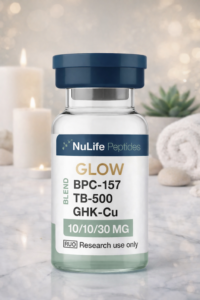
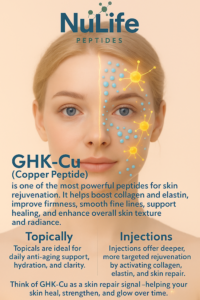
GHK-Cu
GHK-Cu (copper peptide) is one of the most researched peptides related to skin regeneration.
It helps stimulate collagen production, supports wound healing, and may encourage fibroblast activity—the cells responsible for producing connective tissue.
Researchers have studied it for skin rejuvenation, hair growth, and tissue repair.
It works both:
-
topically (skin, scars, glow)
-
injectable (systemic repair + anti-aging)
BPC-157
BPC-157 is widely known for its role in injury recovery and connective tissue repair.
It has been studied for supporting tendon, ligament, and muscle healing. While its mechanisms are still being explored, it appears to influence growth factors involved in tissue regeneration.
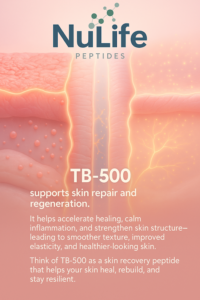
TB-500 (Thymosin Beta-4)
TB-500 interacts with pathways related to cell migration and tissue repair.
It has been studied in regenerative medicine for its potential role in improving healing of connective tissues and supporting structural repair.
CJC-1295 + Ipamorelin — Collagen Through Growth Hormone
You don’t just make collagen… you make it during recovery.
This combination:
-
increases natural growth hormone release
-
improves sleep quality
-
enhances skin + tissue repair
This is indirect collagen optimization—but very powerful
Together these peptides highlight an important idea:
Collagen isn’t just about appearance.
It’s about structural integrity throughout the body.
Nutrients That Help Your Body Build Collagen
Collagen production requires specific nutrients that act as building blocks and cofactors.
Hydrolyzed Collagen Peptides
Helpful—but not magic.
You’re not absorbing collagen directly.
You’re getting amino acid building blocks.
Best used with:
-
Vitamin C
-
A glycine-rich diet
Vitamin C is essential for collagen synthesis and helps stabilize collagen fibers. Non-Negotiable
Glycine+ Proline (Underrated Essentials)
These are the main amino acids that make up collagen.
Low glycine = weak collagen production.
Most modern diets are actually deficient in glycine.
They are amino acids found in collagen-rich foods, are key structural components of collagen protein.
Copper and zinc support enzymes involved in connective tissue repair.
Protein intake in general is important because collagen is a protein structure that requires amino acids to build.
Foods like bone broth, collagen peptides, eggs, fish, and slow-cooked meats provide many of these raw materials.
Plant foods also play a role by supplying antioxidants that protect existing collagen from oxidative damage.
Lifestyle Factors That Protect Collagen
Several everyday habits quietly influence collagen health.
Sun exposure, particularly UV radiation, is one of the biggest external factors that break down collagen fibers.
Sleep is another important piece. Many repair processes—including connective tissue repair—accelerate during deep sleep cycles.
Sleep is where collagen is made.
No deep sleep = no real repair.
Most collagen production happens at night.
Strength training also stimulates collagen production in tendons and connective tissues because the body adapts to mechanical stress by reinforcing structural proteins.
Even hydration plays a role. Collagen fibers interact closely with water molecules, which helps maintain tissue elasticity.
The Best Ways to Increase Collagen (That Actually Work)
Not just more collagen… better collagen production
First, a quick reality check:
Collagen isn’t something you simply “add” to your body.
It’s something your body has to build.
A Simple Framework
-
Signal it
(GHK-Cu, CJC/Ipamorelin) -
Support it
(Vitamin C, glycine, collagen peptides) -
Protect it
(antioxidants, reduce sugar, sun protection) -
Stimulate it
(training, recovery, circulation)
The Bigger Picture
Supporting collagen requires more than topical solutions
Collagen often gets reduced to a beauty conversation.
But biologically, it’s a structural conversation.
Healthy collagen supports resilient joints, flexible connective tissues, strong skin, and durable blood vessels
Aging isn’t random.
It’s structural.
And once you understand that…
you stop chasing surface-level solutions
and start rebuilding from within.
The mirror might show the first signs.
But collagen’s real work happens much deeper.
This is just one piece of the puzzle—more coming soon on how to support structure from within.
If you want to understand how cellular energy impacts aging, read this next → https://nulifeageless.com/2023/06/23/your-skin-isnt-tired-your-mitochondria-are/