
Most people think results come down to what they’re taking.
Which peptide.
Which protocol.
Which trend is working right now.
But in reality?
The difference between average results and exceptional ones usually has nothing to do with the peptide itself—and everything to do with how it’s being used.
Because peptides don’t force change.
They send signals.
And if those signals aren’t delivered clearly… your body simply doesn’t respond the way you expect it to.
WHY THIS MATTERS
You can take the right peptide, follow a popular protocol, and still feel like… nothing is happening.
Not because it doesn’t work.
But because:
-
the timing is off
-
the dose isn’t optimal
-
or the delivery isn’t effective
Peptides are precise.
And your body responds best when the signal is clear, consistent, and aligned with what it’s already trying to do.
DELIVERY: HOW PEPTIDES ACTUALLY ENTER THE BODY
Most peptides are taken through subcutaneous (SubQ) injection—a small injection just under the skin.
There’s a reason for that.
When peptides are swallowed, they’re often broken down before they can do anything meaningful.
SubQ delivery allows them to:
-
enter the bloodstream gradually
-
remain stable
-
reach their target receptors more effectively
In simple terms:
👉 this is how the signal actually gets delivered
And once you get comfortable with it, it becomes second nature.
DOSING: MORE IS NOT BETTER
This is where people tend to overcorrect.
There’s a natural assumption that more equals faster or better results.
With peptides, that’s rarely true.
Too little → no noticeable response
Too much → your body may become less responsive over time
The goal isn’t to push the system.
It’s to communicate with it clearly.
That usually means:
-
starting conservatively
-
adjusting intentionally
-
prioritizing consistency over intensity
RECONSTITUTION: KEEP IT SIMPLE
Most peptides come in a powdered form and need to be mixed before use.
This sounds complicated—until you simplify it.
A consistent method makes everything easier.
👉 A common approach is adding 2.5 mL of bacteriostatic water
Why this works:
-
easier math
-
consistent dosing
-
fewer mistakes
The goal isn’t perfection.
It’s creating a system you can follow without overthinking it. And consistency Is KEY
TIMING: WHEN YOUR BODY IS LISTENING
This is the part most people overlook—and it’s often the missing piece.
Your body isn’t in the same state all day.
It shifts between:
-
activation
-
recovery
-
repair
And peptides work best when they match that rhythm.
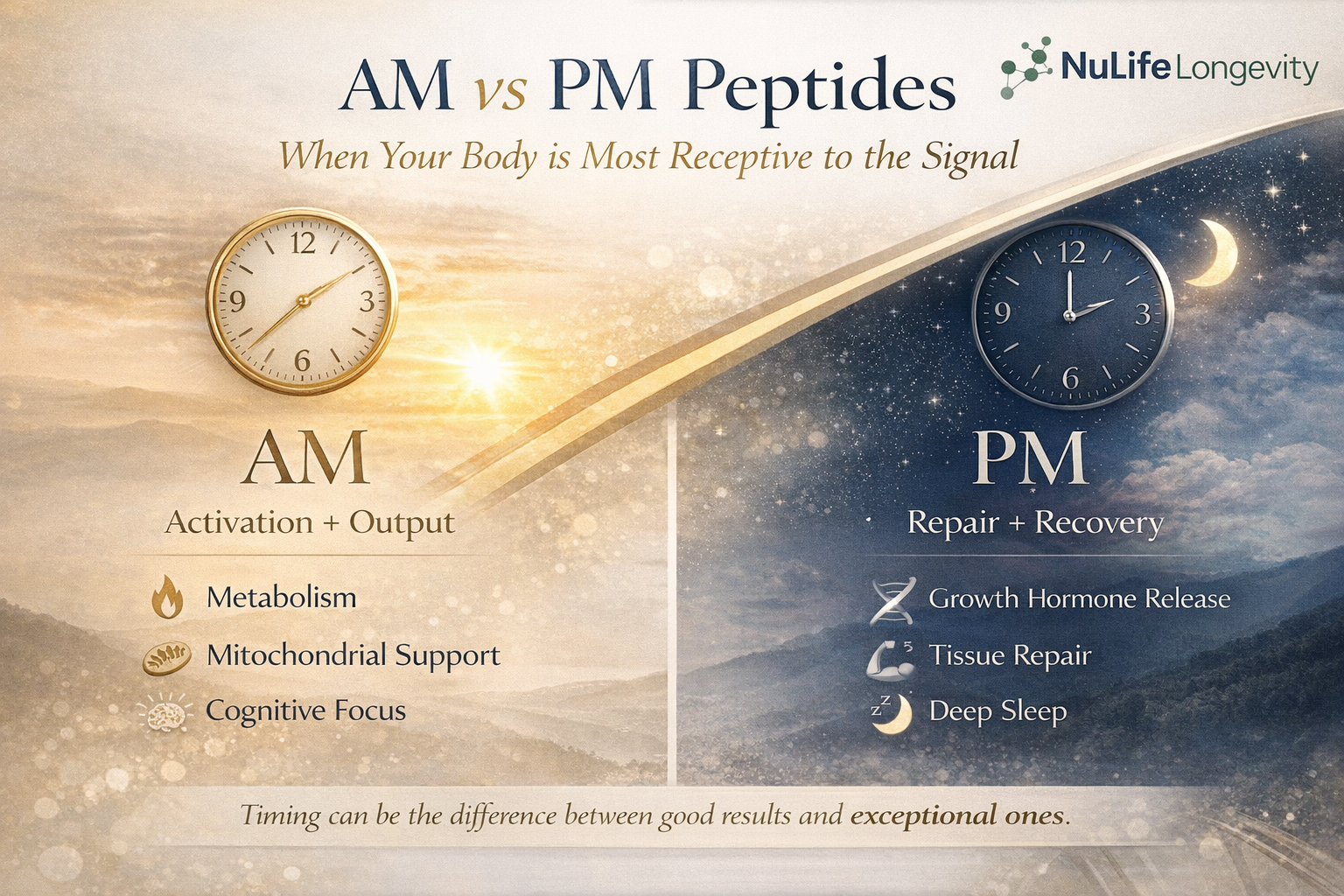
Morning (AM): Activation + Output
Best suited for peptides that support:
-
metabolism
-
energy
-
focus
Your body is already moving into a state of action—so this is when signals that support performance tend to land best.
Evening (PM): Repair + Regeneration
Best suited for peptides that support:
-
recovery
-
growth hormone release
-
tissue repair
At night, your body is naturally rebuilding.
This is when repair signals are most effective.
CONSISTENCY: THE PART NO ONE TALKS ABOUT
Peptides aren’t instant.
They work through repeated signaling over time.
Which means results come from:
-
showing up consistently
-
keeping timing aligned
-
maintaining the right dose
Not from doing more…
but from doing it correctly and repeatedly.
THE BIG PICTURE
When people say peptides “don’t work,”
it’s often not the peptide.
It’s the execution.
Because:
-
Delivery determines whether your body receives the signal
-
Dosing determines how it responds
-
Timing determines how effective that signal is
And consistency ties it all together.
Peptides aren’t about doing more.
They’re about doing things with intention.
And when you align delivery, dosing, and timing…
you stop guessing,
you stop wasting effort,
and your body finally starts responding the way it’s supposed to.